
The Voyage Never Ends

“What does travel mean to you?” A question we all get asked from time to time, if we’ve spent some time on the road, living location-independently, as a backpacker, digital nomad, long-term traveler, or whatever you like to call it.

For me, the difficulties in finding an answer to this question begin already when it only comes to defining and delimiting travel: When does is start? When does it end? The longer we are on the road, the blurrier the answers seem to get. May the meaning of long-term travel be related to losing track of how to confine it?

A vacation, a holiday can be clearly delimited: It could be, for example, a fortnight of relaxation in a nice resort. But travel? Isn’t there more to it than just being on the road? More than just spending a couple of days at a pool bar, more than visiting a foreign country or a new city? In a broader sense, travel is something each and everyone of us does, all the time – both as individuals, and as humanity as a whole.

The Voyage of Humanity

If we look at the voyage of humanity, unfortunately we have to go way beyond cozy hotel rooms and elegant restaurants: There is, without doubt, a dark side to travel and human movement, and I am not talking about the traffic jam on your commute. Just think about the horrors of colonisation, slave trade, or forced displacement caused by wars, natural disasters, and poverty.

How did all this begin? With a universe that is itself permenently moving? With our ancestors, starting to walk on two legs about four million years ago? With the outset of long-term travel almost two million years ago, when homo erectus left Africa? Or only with modern human beings who, as far as we can tell, left East Africa only 50.000 to 100.000 years ago, virtually to “conquer the world”?

And how does this travel end, where does it take us? We managed to colonize the whole planet, but what’s next? Are we up for conquering even bigger spheres, like the Moon, Mars, and Goldilocks planets? Or, much to the contrary, will our travel end in the microcosm, leaving even atomic level behind, reaching quark and string levels? Time travel is another fascinating concept, and although we haven’t been able to make it real yet, we might, at some day.

Spiritual Voyages

The Colombian Kággaba Indians of the Sierra Nevada de Santa Marta are great travelers. They wander around their marvelous mountains, living on different levels of altitude. From time to time, they collect sea shells at the shores of the Caribbean, only to bring them up to the highest peaks of the Sierra, at more than 5700 metres above sea level. By doing so, they establish a connection between the sea and the mountains: a kind of travel, whose material side is complemented with a spiritual aspect. The spiritual representations of the shells travel in another world, called aluna, unseeable for us mere humans. The Kággaba permanently practice a sort of transcendental travel between our material world and the untouchable, yet for them far more relevant world of aluna.

If we look at travel in a broader sense, we must consider these spiritual voyages, that are usually smiled at by scientists and natural philosophers since the Renaissance: Are we able to transcend time and space to visit God, meet him for a chat? What about telepathy? What about the ungraspable scope of drug-fueled trips into consciousness? And, finally, what about the travels we realize in our dreams? Even if we were tied to bed with a horrible illness, not being able to see, hear, talk, or move us, couldn’t we still be traveling? Our mind, I guess, might be wandering as long as we are alive.

Individualistic Travel

But what if we are neither spiritual voyagers, nor rocket scientists, nor quantum physicists? Delimiting travel can still be tough. For example, I have spent more than two months now in one city, living in the same room. Have I stopped traveling already? And when did I start? When I left Germany almost ten years ago to spend my first year in Colombia? (Was that traveling, or living abroad? Was I an expat?)

Does our voyage start with the sexual intercourse of our parents? Does it start when we leave the womb, or when we move out of our family’s house? Many people will be convinced it ends with death – but only as long as we don’t believe in Heaven and Hell: From a religious perspective, death might only be the start of our more important travels. Or it might lead us to a circle of resurrections, that may be broken one day as we reach Nirvana, the state of mind which “no longer is coming (bhava) and going (vibhava)”, but which “has attained a status in perpetuity“. Travel would probably end here, but would we still be humans, then?

The Meaning of Travel

What does travel mean? After all we’ve seen, travel, in the material world and in the sphere of thought and spirit, seems to be part of the human condition: We are permanently moving from one place to another, if we like it or not. Maybe we travel because of necessity, in search for a better place to live. Maybe because we are forced to. Maybe for adventure, honor, or the pure joy we feel when crossing borders and boundaries that were hold up for centuries, before we decided to accept them no longer.

Even if we were born into the most comfortable life, we still have to move, we still find ourselves traveling: We might be provided with an “all-inclusive package for life” by our parents, yet we don’t know what will happen during our trip, and if it works out as planned: Our plane may crash down, or we might find the love of our lives.

The meaning of travel, then, must lie either in its divine ground or, in an existentialist sense, in the meaning we decide to give it. Our individual travel can be motivated by feelings of isolation and fear, by necessity and longing. At the same time, it can also be motivated by our wish to experience this world and its beauty first hand, to transcend the boundaries perceived by us personally or by the human race as a whole. Whatever it may be, we have to move. And we should consciously decide about it, or we will die in bad faith, without ever realizing our true potential.

Mindset and Meaning

In travel, as in the whole life, there’s no objective value in permanently crossing borders. It doesn’t matter how far we travel, or how many places we visit. What matters is the mindset with which we approach them. Essayist Alain de Botton gives a nice illustration of this: Imagine a hundred people sitting on a plane to Berlin, Bogotá, Bangkok, or almost any place in the world. Half of them might be displeased to reach their destination. They may be coming home from holidays, and they fear the boredom or the unpleasant tasks of their daily lives ahead of them. At the same time, the other half might be thrilled and happy, about to meet some dear friends, or to get to know a new city. Yet all of them are going to the same place! The difference is their attitude towards it.

Once we accept travel as part of the human condition, we may fill it with meaning on our own, no matter where we currently happen to be. In the end, de Botton says, travel is about being receptive, which requires an attitude of humility and overcoming our “rigid ideas about what is or is not interesting”. We can travel spiritually or in our dreams, we can travel to exotic places. But we can also travel in our immediate surroundings: We can visit a new neighborhood, walk a new road, choose a new means of transport. More importantly: We can speak to new people, listen to their thoughts and beliefs, give them a smile, help them if we can.

When on the road, anywhere and everywhere, we should notice, not just look. Smell, not just breathe. Listen, not just hear. We will be able to find interestingness within the known and the unknown, and this is where I suspect we will find real meaning in our voyage. It’s a very personal decision of each and everyone of us how far we want to go, but as long as we are alive, we will always be part of this immense travel community called humanity.


This post is my entry to become the next Flightster travel writer. I decided to think about the deeper meaning of travel on this occasion, and hope you enjoyed the resulting post. Now, for a change, you might be up for some lighter travel writings! Please feel invited to read my post on eating the whole cow, and nine other things I learned in Colombia! :)
A Trip To Outloggistan

Another month, another bunch of problems with my internet provider. Without any apparent reason – bills are paid on time, cables look fine – the service gets suspended. This seems to happen every couple of weeks, and as much as it gets on my nerves, I was wondering these days about whether there wasn’t some beauty, even a commercial potential to it.

Let’s just imagine if all providers out there would cut our internet access from time to time. In total irregularity, you are sent on a trip to this strange country called Outloggistan, far away from all your favorite websites and computer clouds: On Monday, you are fine, but then, Tuesday at 9am, the web is down. They take you by surprise, and you don’t know when it will return: Maybe within a few hours, but more likely only after a couple of days.

Suddenly, you are free. You are free to leave your house, your office – ideally you don’t own a laptop, so you leave your computer at your desk -, free to take a stroll and look around, with nothing but a paper notebook and a fountain pen on you, maybe a camera, if you own one and happen to be interested in photography.
You have the time to speak to your neighbors, because you’re not missing anything on Twitter, Facebook, your email inbox. (Or maybe you are, but you just don’t know, can’t know, won’t know.) If you’re lucky, cellphone companies will join the good example of your ISP, and there will be no signal for you. You aren’t able to call your boss, your friends, your colleagues, you cannot schedule anything, not even a meeting to put the free time to “good use”.

Relaxation (And Offline Productivity)

You see a burrito vendor, and mentally trade off the possibilities of catching salmonellae against enjoying a relaxed and hearty breakfast like you didn’t have one in months. You observe a beautiful girl in a yellow skirt, diving into the morning light that floods around the walls of the corner shop. You are free to sit down for coffee, instead of taking it with you as you rush through the city, and you are free to take a nap on the rotting wooden banks on that tiny plaza you only used to know from your breathless walks, crossing it on your way to “more important” events.

Without any stress at all, you are free to take out your notebook, your pencil, and start doing your work, start outlining a new post, start bringing new thoughts to life, creating a whole new world just by writing about it. You may also start to doodle, scribble, or you may use that camera and start taking pictures with all the time in the world. Nobody rushes you anymore as you start diving into your creative craftwork.

Starting. The magic of getting started. That’s what the internet is making so incredibly difficult. Because there’s always something else to read, something else to open, something else to download, to click on, to install and to look at, to sign up for, to wonder about, all the time. (There, a new email! What might it be? Oh, just another of these boring mailing list announcements. You wanted to get rid of that subscription months ago already. But wait, there’s this friend of yours on that list, and he needs to be contacted because of what John said, the other day. You should call him right away!…)

Nested Distractions (And How To Avoid Them)

The trouble with the internet is that one distraction leads to another. Within seconds, they become nested, interlaced, impossible to separate: The web invites our brains to hyperlink. We only wanted to check that word in the online dictionary, but then we see that ad and it triggers a memory, we rapidly open that website in a new tab, post the link on Twitter, and – boom. We’re lost.

To some extent, this hyperlink structure is exactly what we are looking for in our creative ventures: We want to access information from different parts of our brains, we want to connect these pieces, glue them together in order to create something bigger, getting our work done. Paradoxically, the same trait that helps us doing these things is also the one that makes it more and more difficult. It’s only a thin red line we have to cross to leave the sanctuary of inspired productivity and enter the war zone of overwhelming distractedness.

That’s why diconnecting from time to time is so powerful. The thin red line disappears, as does distractedness. There are tools available that will block your computer for some minutes each hour – and once you activate them, you are not able to turn them off anymore. They force you to take a small break each hour, or at least to dedicate these minutes to some activity away from your screen. The alternative? Imagine a telco offering a complete service package with at least five days of guaranteed downtime each month. For the same price of a normal 24/7/365 connection, you could get all the power of the web plus a couple of weeks in Outloggistan. Wouldn’t that be worth your money?


Illustration based on a photo (cc) BY Irene2005.

Balance

“Live your dreams” is one of those phrases. One of those phrases that seemed light, easy, and motivating a long time ago, but then were so overused that they lost their appeal. First, there were our parents telling us that “we could make it” if we really wanted. They had all good intentions, but then their version of the “American Dream” became swept away while we were just growing up. Then, self-help authors and motivational speakers joined in, but their advice felt like generic prescriptions in our medical history of life. The effects were minimal, as if they had handed us placebos. After that, the marketers came, and that’s when the phrase became completely void. They told us we were living the dream if only we bought their watches and their running shoes, their cars and their vacation packages to Cancún.

But do things have to be like that? Wouldn’t it just be fair if we humans – buzzwords aside – really were able to follow our dreams and build our lifestyle upon them? What’s the trouble with dreaming, and why do dreams so often lead to nothing but despair? Danish philosopher Søren Kierkegaard offers an explanation based on our human nature: “A human being is a synthesis of the infinite and the finite, of the temporal and the eternal, of freedom and necessity.” If he’s right, we have to try finding a balance between these two sides, or despair will occur: If we focus on the infinite, the eternal part of our being, we risk to remain dreamers forever, without ever taking the steps to make our dreams come true during our limited lifetime. If, on the other hand, we focus only on the finite, the temporal element, we will feel limited and reduced to our flesh, unable to concentrate on the important aspects of life. We’ll spend our years on Earth running like a hamster in his wheel.

Kierkegaard, as many other philosophers, see us existing in a middle position: We are free to dream and to decide upon our lives, but as we are limited as human beings, we lack any kind of divine control about it. If we want to make our dreams real, then, we’ll have to do it by our very own means, striving for balance between the two sides of existence as good as we can.

Even as an agnostic, I am often contemplating about these cicumstances, and about how they affect us on a daily basis. Balance is also a recurring topic here on The Friendly Anarchist: How can we balance idleness and action, productivity and unproductivity, our life project and the unimportant but unavoidable tasks we have to take care of?

For me, the balance between the finite and the infinite, the temporal and the eternal, freedom and necessity has to be established from scratch day after day. This can be seen negatively, resulting in permanent anxiety and a longing for a more stable solution. An optimist, on the other hand, would consider it an amazing opportunity of empowerment: We are free to take our lives into our hands every single day. As we wake each morning, reality opens up for us. The sun rises, and there’s a new day for us, like a blank page in a book that has yet to be written.

Even if our personal book of life has been full of despair for decades, we are free at any moment to change the story, and put it into balance. If we ignored the infinitude and lost years in aimless busyness, running in our hamster wheel, we may start to dream and get in touch with the infinite part of human existence. If we were mere dreamers, on the other hand, lost in our thoughts and phantasies, we may consciously decide to escape this limitation, and start taking concrete steps towards making these dreams real.

The phrase “Live your dreams”, then, doesn’t have to remain as hollow as it may appear at first look. It just needs to be understood as a part of the balance of our existence.


Wondering how to find the courage to follow your dreams? My friend and coach Jonathan Mead just released the second edition of his marvelous ebook Reclaim Your Dreams. Feel free to check it out.

Illustration based on a photo (cc) BY-NC-SA Zebra Pares. Disclaimer: I’m an affiliate of Jonathan’s products and may make money if you buy anything from him. You probably should do that, as his products are great and I’d like to retire young and wealthy.

The More You Procrastinate, the Better You Get

Procrastination suffers from bad reputation. We see it as something natural and normal, yet ultimately undesirable. A lot of productivity evangelists and self-pronounced personal development warriors made things worse, declaring procrastination part of the axis of office evils. As such, it had to be fought, even if that meant committing war crimes against your inner idler. Sometimes, when reading about all these campaigns against procrastination, I am reminded of the fervor of the (not so) holy inquisition. It makes the lazier part of ourselves feel like a tormented freethinker in an age of productivity orthodoxy.

What puzzles me, though, is that many of the persecutors of procrastination cannot really know against what they are crusading. If they would, they couldn’t possibly be so productive, posting two times a day on their blogs, answering a million emails, and traveling from conference to conference to spread their enlightened words. Still, they claim to “understand” the alleged suffering caused by what Germans chicken-heartedly call “postponitis”, as if it was a more infectuous disease than the bubonic plague.

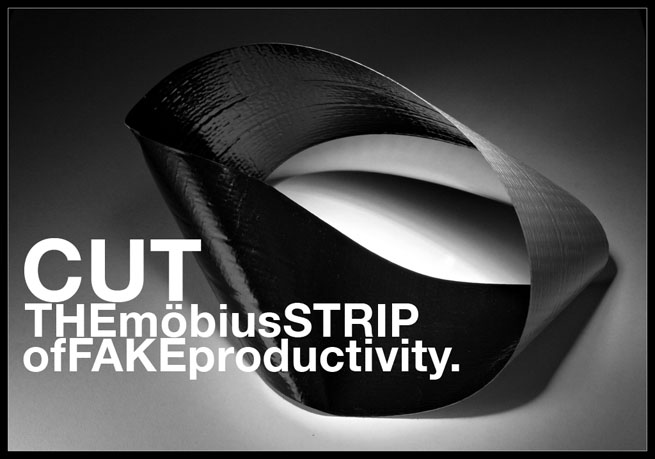
The Moebius Strip of Fake Productivity

Do you want to hear my take on all this? Bollocks! The real problem with procrastination is that people don’t know how to cope with it. And this comes to no surprise: We live in a culture of wannabe effectiveness and fake productivity, teaching even young children to make impeccable use of their time. Most 12 year olds in the suburbs of the USA seem to have a tighter schedule than I am ever going to have. Relaxing and doing nothing, they are taught, is a bad thing, just like using swear words or eating their finger nails.

As a result, people often fall into a trap I’d like to call the Möbius Strip of Fake Productivity: You don’t feel like you’re ready to work on any task that matters, but you don’t feel you’re allowed to do nothing, either. So you will just nervously fill up your day with minor tasks, getting nothing important done, but neither taking the time to relax and give your idle brain some freedom. Just like walking on a Möbius strip, you could go on and on and on like this until you reach retirement age.

The alternative? Embrace this lovely human quality called procrastination! Grab your scissors, cut the möbius strip, and decide to turn pro not only in your work, but also in procrastination. Both things have a place in our life, and both can be embraced.

The Decision between Work and Idleness

The next time you suffer from procrastination, why not take a step back and look at it from a distance? Instead of getting nervous and starting to do anything just to feel “busy” or “productive”, ask yourself the following questions:

  • Is the task you’re procrastinating on relevant and important?
  • Does it really have to be done?
  • Does it have to be done by you?

If the answer to any of these questions is “no”, consider dumping the task right away. Let someone else do it, or just decide to cancel it all together.

If the answers are yes…

  • Ask if you maybe just need a break.
  • Ask if the task has to be done now, or if you should be doing it later.
  • Ask if there is something of higher importance you feel like doing at the moment.

Procrastination is not an evil. It’s either your body or your brain sending you an important message, but you decide to ignore it and instead start responding to meaningless emails. Remember: It is only natural to feel exhausted sometimes. Also, your brain might just want to point you at something else you had to do but pushed aside earlier. Be observant of these things and find out what your procrastination really is about. If no important work needs to be done, don’t be shy to enjoy idleness.

How to pro-crastinate

Procrastination, like everything, takes some time to be perfected. The more you procrastinate, the better you get. All these self-help authors who haven’t done their 10.000 hours of it should just shut up.
Believe it or not, procrastination is a form of art, and it can be a pleasant use of your time. But it never will be, if you only feel remorse and qualms instead of taking it for what it is: An inherent part of work itself. Don’t spoil it by adding stupid tasks to your day, or it will just get worse the next time you get back at what you were initally wanting to do.

Here are some ideas on how to spend some great hours procrastinating like a pro:

  • Take a nap.
  • Look at the sky. (If you’re inside, go out.)
  • Take a walk.
  • Meditate a little, even if you don’t know how. (Just follow your intuition. You don’t need to attend a course for that.)
  • Skribble. (Doodle, as other people say.)
  • Do some yoga. (My friend Nate can teach you how.)
  • Invent dinner. (Go get the ingredients, if necessary.)

Also, don’t be selfish! Share the love and procrastinate with others:

  • Call an old friend or family member and talk for an hour.
  • Upload the photos from your daughters birthday and send the link around.
  • Have coffee and a chat with your boss.
  • Recommend good reads on Twitter.
  • Send me an email with a good story or an interesting question, or post it in the comments.

Psst! Liked this post? Then please share it on Twitter or recommend it to your friends. It would be a great help! Also, a big thank you to spacepleb for the awesome photo I used above!

Good Reads, Back in the 21st Century Edition

A Willingness to Remain SilentBlogging is linking. I think you see this in many posts I write – but unfortunately, I cannot include links to all the inspiring reads I encounter during my voyages through the (mighty) interwebz.

That’s why I decided to create a column to spread a few precious links worth your time, and also share some personal updates with you. (As for that, the silence last week is owed to the special “You pay the bills, we disconnect you” weeks sponsored by Telefonica, followed by power outages and burning transformers sponsored by Electricaribe. I am now officially back in the 21st century, at least as long as it doesn’t rain. Living on the cheap in the Caribbean is great fun, but you have to bring some patience. In the end, the beach is even nicer when it rains.)

No worries, though: I won’t start to bomb you with noise. While there are many good posts out there, I only want to post stuff that really struck with me and that might be valuable to all you friendly anarchists out there. Thus, I won’t have a schedule for these posts, but only do one once in a while, whenever I found enough links worth sharing. If you have any proposals, feel free to get in touch!

[¶]

“Those who dream by night in the dusty recesses of their minds wake in the day to find that it was vanity: but the dreamers of the day are dangerous men, for they may act their dreams with open eyes, to make it possible.” (Metafiltered Crowd Wisdom curated by Colin Marshall.)

[¶]

“You want to be a visionary? Stop reading Seth Godin and take some psychedelics. Then you will be a visionary.” (@ericschiller)

[¶]

“Here’s what I think about lifestyle design being a bubble ready to burst:

1. Lifestyle design is a rebranding of ‘improving your life’ by Timothy Ferriss.
This means that anyone working under the moniker has to deal with associating themselves with him, which makes it difficult to find their own voice.

2. There will never be enough writers encouraging people to live their lives.
Too many of the souls on this planet are wasted. People spend their entire lives waiting for a retirement that will never come, because they’ve been taught by the system to keep their heads low and wait for their big payday. It isn’t coming.

3. There is more than enough room on the Internet for all of us.
If you read The Long Tail by Chris Anderson, you start to realize just how freaking big the Internet is. Even the 172,000+ subscribers that Leo Babauta has isn’t touching the tip of the iceberg for people that are interested in this living a life that is better than the one they have. That’s because most people have sucky lives that they hate, and they can do a lot to do them better, they just need permission to do them better.

4. There’s room for you too.
Write what you believe, write about the life you dream you’d have. If you lead enough, the people will follow. You only need 1000 true fans to support yourself, and then you can do anything you want — I know, because I crossed that threshold earlier this year.

The planet is freaking huge, and we’re all connected now.”
(Everett Bogue in the comment section of Lifestyle Ignition. Word. All I can say. Word!)

[¶]

“So the thing is… people have become obsessed with avoiding danger these days. Problem is, danger is hard to avoid.” (@johntunger in a great multi-tweet rant on Twitter. I saved the whole thing for humanity on my Tumblog.)

[¶]

“Almost anything can be made playful, and therefore enjoyable. I’m not saying that you should try to transform the things you hate doing and do them anyway with mind-blowing excitement and euphoria. You can happily stop doing those things any time (you have my permission).” (Really useful self-employment lessons by Jonathan Mead of Illuminated Mind.)

[¶]

“So, after much trial and error, for the last five months I’ve stuck to a schedule of 1000 words a day, Monday to Friday (with the occasional holiday and break thrown in). Some people may balk at this puny 1000 words, after all if a typical book averages 100,000 words it is a mere drop in the ocean. That’s how I felt at first. But five months later I’ve done 85,000 words and counting!” (Yay! James Mallison of Part Time Wage Slave writes a book, tempo giusto style. Consistency is king!)

[¶]

“The thing that bothers me more than anything is that Wage Slave Rebel has slowly morphed from something that at least aspired to be revolutionary into something that looked exactly like every other “revolutionary” blog out there. It stopped being an authentic call to arms and instead transformed into bullshit marketing. I’m reminded of this any time I visit a self-described lifestyle design site. They seem to think that it’s revolutionary to become the oppressor instead of the oppressed.” (JD Bentley is changing the way he blogs on Wage Slave Rebel.)

[¶]

“Slow Blogging is a willingness to remain silent amid the daily outrages and ecstasies that fill nothing more than single moments in time, switching between banality, crushing heartbreak and end-of-the-world psychotic glee in the mere space between headlines.” (A slow blogging manifesto by Todd Sieling.)

[¶]

“Never forget the things from which you’re escaping.

I walked past an office building in downtown Montreal this evening. I was on my way to meet my girlfriend for a family meal, which we would follow by attending a magazine launch party. Inside the office, meanwhile, the desk jockeys were working overtime beneath florescent lighting.

No more of that for me, thanks. I felt immediately grateful for the fact I was on the outside of the stone wall and not on the inside any more.” (Robert Wringham of New Escapologist remembers what we’re escaping from.)