
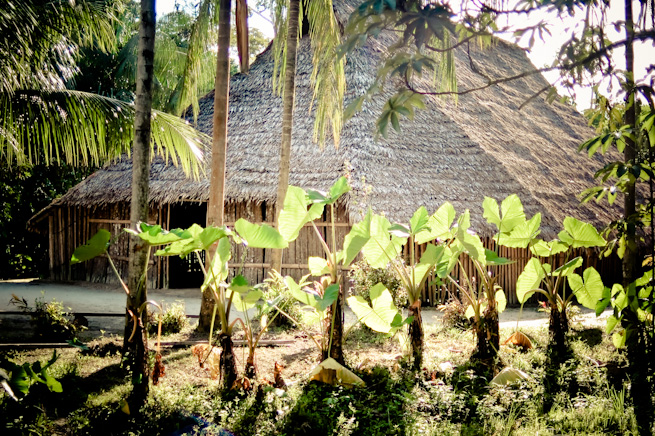
Maloca in the Amazon

Ready to Celebrate

I heard the cries from the forest. Far away at first, damped by the noise of the cicadas, ((A marvelous noise, by the way. Click that link and listen to tracks number 7 and 16 to get an idea.)) but approaching fast. The cries were human: They originated from people that were coming nearer, and from all I could tell there were a lot of them. Even though I had been warned in advance, it still gave me the creeps.

I was standing in the darkness outside the ceremonial house in the middle of nowhere, not even sure if I was still in Colombia, or already on the Brazilian side of the border. Down here in the Amazon, nobody cared.

As the people approached, I stood in awe: They were walking way after dusk, crossing the pitch-black forest without any lights, while I already felt lost when merely departing more than three steps from the door.

With the first Indians reaching the house – smiling, joking, laughing – my tension vanished: The guests had finally arrived, and the festival was ready to begin.

[¶]

“You have to celebrate when you’ve got the chance,” a German proverb goes. ((Interestingly, I couldn’t find an English equivalent. The closest seems to be “One must make hay when the sun shines,” but that of course comes from a work rather than a leisure perspective. If you have any additions, feel free to post them in the comments!)) Unfortunately, we are often so entrenched in our daily routines that we don’t even notice the upcoming chances to celebrate – and if we do, we let them pass because “tomorrow we’ve got to work,” or “there is still so much else to do.”

I observed this recently when talking to my friend Christine about how we got our college degrees, but never really found the moment to celebrate it. Between the hand-over of our thesis and the emission of our marks and diplomas, so much time had passed that we simply forgot about it.

A similar thing almost happened after finishing Beyond Rules. Instead of celebrating, I stressed out about getting my inbox back to zero and keeping up with other commitments. I was about to enter “do mode” once again; a state that obviously doesn’t really allow for true celebration.

From a tempo giusto perspective, forgetting to celebrate is ultimately an indication of time anxiety and even poverty: “A festival is essentially a phenomenon of wealth; not, to be sure, the wealth of money, but of existential richness,” Catholic philosopher Josef Pieper wrote. It is this existential richness that I needed to reconnect with, and my experience down there in the jungle between Colombia and Brazil seemed to be the clue that I needed.

[¶]

In the afternoon, I had helped the chief to prepare his birthday soup. One of the men had brought a capybara from the woods, the largest rodent in the world, akin to a giant guinea pig. He had skinned it and chopped it into pieces, while the rest of us had gotten wild lemons and cilantro leaves, and prepared a tasty stew with exclusively natural ingredients. Meanwhile, we had talked and snorted tobacco.

Coca leavesBurning leaves

I had also been present during the preparation of mambe, a powder made of toasted coca leaves and the ashes from burnt Cecropia leaves. The Indians enjoy chewing it, and they chew whenever they can. After a ceremonial introduction, my friends and I were allowed to chew it, too. We almost suffocated because of ignoring the chief’s advice to not breathe for a minute after taking the fine powder into our mouths; but after a while, we got the hang of it, and we enjoyed it just the way the Indians did.

Now, everything was prepared, and the other guests were arriving: It was a gathering of five indigenous tribes, somewhere in the deep woods of the Amazon rain forest – and I was right in the middle.

[¶]

If I compare the chief’s birthday to most birthday parties back at home, the Indians win hands down. There were no people worrying about next day’s work, or complaining about their bosses or low salaries. As Nietzsche said, “the trick is not to arrange a festival but to find people who can enjoy it.” And the guests at the chief’s birthday certainly knew how to do that!

As much as I think about it, I have rarely attended a feast so harmonious and absorbing. Unfortunately, festivals and parties in Western cities are often boring, over-commercialized, and in some strange sense unfulfilling. For Josef Pieper, the diagnostic is clear: According to him, a real festival has to be based on a religious ground.

In the rain forest, there certainly was some religious aspect to it: Snuffing tobacco and chewing mambe was at least as much a sacrificial offering to Mother Earth as it was personal indulgence; and the group dances and songs during the night were at least as much an incantation of the guardian spirits as mere entertainment.

But even if we ignore his call for a religious component of any worthwhile festival, Pieper has a point when he writes: “To celebrate a festival means to do something which is in no way tied to other goals, which has been removed from all ‘so that’ and ‘in order to’. True festivity cannot be imagined as residing anywhere but in the realm of activity that is meaningful in itself.”

Could it be that, over our obsession with work, productivity, and efficiency, we have forgotten how to celebrate?

[¶]

What really stuck with for months after the birthday party in the Amazon was its intensity: Everything was purposeful, from the repartition of the food, to the coca-chewing, to the jokes that were told in smaller groups. Every couple of minutes, someone would make the same cry I had heard earlier, and the whole lot of people in the house would join in. It was a cry of approval, of happiness, of general agreement with what was happening and with the stories that were told.

Dog sleeping inside the malocaHours later, the visitors were ecstatically dancing in the ceremonial house, me among them. Still later, I was dozing completely exhausted in my hammock in the same room, while the elders continued to dance and chant.

I don’t know if it was the coca, or their happiness, or their overall condition, but it certainly was impressive: These elders were all past retirement age. They had hiked for three or more hours in difficult terrain. Many of them didn’t even have shoes. And they still were dancing and singing and laughing all night long, until dawn, and then some. When the sun started to rise, they hugged the chief and set about to walk another three or more hours back to their villages.

“You have to celebrate when you’ve got the chance.” The Indians certainly had taken theirs.

[¶]

This brings me back to my question: Have we forgotten how to celebrate? From personal experience, I cannot agree completely. Even though it doesn’t happen every day, there are some wonderful festivals going on pretty much anywhere, no matter who’s around, when it occurs, and where you’re at.

Still, many of those parties, club nights, and sit-ins lack this special feeling that makes a festival really worth our time: How often do we get to the point where we transcend our normal lives and enter a kind of sacred zone, this curious place where we can be totally relaxed and totally ecstatic at the same time?

Celebrating a festival means approving the world at large, even if we may not approve the details – “such affirmation [is not] shallow optimism, let alone … smug approval, of that which is.  [It] is not won by deliberately shutting one’s eyes to the horrors in this world. Rather, it proves its seriousness by its confrontation with historical evil,” as Josef Pieper puts it. ((The English-language quotes taken from this site. It also provides a good overview over Pieper’s theory of festivity.))

Despite the bullshit that’s happening in the world, there is still a reason to celebrate, and this reason is that there is something rather than nothing, life rather than merely dead matter. I leave it to you if you want to attribute this astonishing fact to God, Mother Earth, the Spaghetti Monster, or the Big Bang. But I wholeheartedly agree with Pieper that the fact alone is worth celebrating – and by celebrating it, we grab an opportunity to transcend the world of work, rationality, lack, and worry.

I suppose the way to attain this state more often is to be open for it. Let’s celebrate when we’ve got the chance, even if we didn’t put it on our agenda weeks ahead. This may mean partying hard, or sitting down to meditate, or going on a road trip with a friend, or visiting our grandmother with lots of time for tea and cookies. But it definitely means taking some time out of our busy schedules, and embracing the moment and the occasion – simply because we can. Even if we have to walk a couple of hours through a metaphorical rain forest around us.

“The cult has in regard to time a similar meaning as the temple in regard to space,” Pieper writes. By celebrating, we can take time out of its normal context, and dedicate it to the Gods, or to life, or to whatever we feel comfortable. It is, in this way, a huge and enjoyable step towards living tempo giusto.

The Clean State (and Chicken)

If people would spend the same time to research the next laptop they plan to buy as they spend to think about their lives, they would come home with an electric blanket.

I was remembering the phrase that made me go on this trip, as I embarked on a small vessel in the river port of Manaus, the inofficial “capital of the Amazon,” and an island of modern civilization in an ocean of impenetrable jungle.

After finishing my diploma thesis earlier that year, I had decided to postpone my career, and use some travel time to seriously think about my life. Now, in the middle of thousands of Brazilians screaming way to fast Portuguese for me to understand, throwing firecrackers because of some obscure holiday, drinking Cachaça, and dancing to the newest Forró hits that had made it to the jungle, I was asking myself if this was the adequate place for my endeavor: I really didn’t want to come home with an electric blanket, but I wasn’t sure if I would find anything better on this trip.

Until now, the voyage had been absolutely pleasant, but it hadn’t lead to the bigger insights I was waiting for: I had enjoyed traveling with two dear friends through the Orinoco and the llanos of Venezuela; I had biked through the wonderful mesa landscape near Santa Elena del Uairén; and I had gotten a lot of new impressions, ranging from horrible Venezuelan light beers to the currency black market in Arab-owned shops all over the country.

What had been missing, maybe, was the time and place for some real reflection – and seeing the scene at the harbor, I wasn’t quite sure if I would find it aboard.

I didn’t know yet how unfounded my worries were, when I put up my hammock among the ones of about three hundred other people who were about to accompany my week-long trip to the frontier with Colombia and Peru, some 800 miles upstream the second longest river in the world. Coincidentally, it was precisely on this old vessel where I would find what I was looking for, even though it would be quite different from what I had imagined.

Life Aboard

You see, life on a combined merchant and passenger ship on the Amazon is pretty repetitive: Either you get on a party vessel where everybody drinks Cachaça until they drop, day after day, night after night – or you get on a ship with a captain that’s a member of some dubious Christian sect and doesn’t allow booze on board. By pure chance, I got on one of the latter, and while I wouldn’t have guessed it, this wasn’t the worst thing that could have happened.

The day aboard would begin around 6am, when crew members started to shout and run around, and breakfast was served. Everybody would rush to the small kitchen to get some cookies that tasted like turf, and a plastic cup of oversweetened coffee. Afterwards, some people would take a shower in one of the four or five bathrooms, while the rest would just go back to their hammocks and wait for lunch.

Lunch, that meant rice, beans, and frango (chicken). Every day.

After lunch, one would wait for dinner.

Dinner, that meant rice, beans, and frango. Every day. Day after day.

The frango diet was so intense that it made me write a song, that due to my limited Portuguese just goes like “Frango, frango, frango,” repeated in different melodies from cheesy Latin American pop songs.

People on board liked the song, because they liked the frango.

As you would really mess up your back by lying 24 hours a day in a hammock, most of us would normally walk around the boat quite a bit: Checking out the storage area on the first deck downstairs, or having a cold beer in the small cafeteria on the upper deck. (Beer, opposed to Cachaça, wasn’t prohibited by God, or the Captain, or whoever decided on those matters.) One would talk to the other travelers, mostly Brazilians who went back to the remote villages they lived in, or to one of the five other foreigners on board, traveling from Colombia, Argentina, and Portugal.

Apart from that, not too much was happening.

The Joys of Uneventfulness

The funny thing about this trip is that there isn’t really much to say about it – and, still, there would probably be enough material for a whole book.

Considering the low level of activity, the long lines to get some really boring food, the shabby showers, plus the fact that you couldn’t leave, it was a bit like a floating jail. On the other hand, all the “inmates” were so nice, and the atmosphere so relaxed, you could just as well call it a meditational retreat.

All we saw, apart from ourselves, was nature. When we were driving close to the shore, we could see the monkeys playing in the trees. At times, we had torrential rains for hours – at other times, the sun burnt so hot we could barely stand it, and there were always some electrical storms going on somewhere nearby, so we could observe the lightning.

The atmosphere of this uneventful (yet still enjoyable and – in an uncommon way – surprisingly interesting) part of the trip was precisely the atmophere I needed to reflect: After four days of nonstop travel, I was lying in my hammock, looking at the forest and the occasional hut passing by – and it simply was the most relaxed state of mind I ever had experienced.

Not that my life had been utterly stressful before, but after finishing a large layout job, writing my thesis, getting sick, moving out from my apartment, and all things related, I had noticed the necessity to reduce my pace of life, in order to think about what to do next. That sunny day, in that scuffed hammock, on that old vessel somewhere on the Amazon, I slowed down so much that I was barely breathing anymore. If at that moment a physician would have tried to take my pulse, he probably wouldn’t have found one.

A Lesson in Tempo Giusto

The ultimate reduction of speed I experienced aboard that vessel on the Amazon was the tempo giusto equivalent of “going to space,” as described in chapter 4 of Beyond Rules: Sometimes, we need a clean state.

Sometimes, we need to let go of all the things that distract us, stress us, make us nervous, keep us occupied; we have to escape day-to-day business and busy-ness, in order to get our head clear. As for any serious situation in life, there is a Tyler Durden quote to dramatize it a little: “It’s only after we’ve lost everything that we’re free to do anything.”

Of course, we don’t have to literally lose everything – but we have to let go of it at times. It wasn’t that I reached tempo giusto there on the boat. Tempo giusto means slow as little as it does mean fast. It means the right speed.

But it was the ultimate slow-down to the clean state of zero that gave me the opportunity to consecutively speed up again, and then find my personal speed of life – and that was what I was subsconsciously looking for all the time, even though I didn’t know it when starting my trip.

On the Amazon, finding the answers to my questions was as simple as seeing the sun set in the river in front of me, sitting in the bow of the ship; only to turn around, and go to the stern, in order to see the full moon rise from the same river behind us.

It meant creating a clean state by doing nothing; creating a clean state by stopping to do anything; creating a clean state by stopping to try to do anything; by accepting that the solution to the riddle might not be something I could find by force, but rather by simply being receptive.

As improbable as it sounds, letting go of it all – trusting in the power of our idle brain – sometimes is exactly what enables us to understand what it is that we have to do, and to get moving again.

In this sense, a clean state can serve as a platform: A platform to build upon; creating precisely the thing we want to create, or simply coping contentedly with whatever it is that life is giving us. Even if it’s just rice, and beans, and a mouthful of Brazilian chicken.


This is the first part of my Amazon story (mentioned in Beyond Rules), that many people had asked me about by mail. In the second part next week, I will take you into the middle of the jungle, to join an Indian feast.

The Right to Remain Silent

It was quiet on The Friendly Anarchist since my book launch. After finishing the work, it somehow came natural to be silent for a while. During the last couple of weeks, though, there was something else to it: I wasn’t feeling at ease, and I wasn’t living tempo giusto – which is why I got lost for a while.

I didn’t enjoy launching the book at that date, because of the events in Japan. I felt it wasn’t a good moment, I felt there were more important things to write about, and I wasn’t happy to see the reaction to the catastrophe in much of the blogosphere, nor in the mainstream media – but I neither had a better idea about what to do.

After Japan, the more thoughtful responses and analysis seemed to get lost in an avalanche of pearl harbor tweets, pseudo-esoteric “universal justice” bullshit, and a political response of helplessness. Many news outlets seemed to be hoping for a rapid meltdown in Fukushima just because they wanted the scoop.

And then, there was so much more going on in the world in the last few months: The revolutions and uprisings in Tunisia, Algeria, Jordan, Egypt, Yemen, Lybia, Lebanon, Oman, Syria, Iraq, Bahrein, Iran. The earthquake in New Zealand. The bombing in Moscow. The floodings in Brazil and Australia. In Colombia, the worst natural disaster in the country’s history took place without most of the world even noticing it.

Considering all the stuff that happened, I was simply tired. My capacity of processing all this information, the images, opinions, thoughts and discussions somehow had reached its limits. Uneventfulness seemed to be something thoroughly desirable, and this is, somehow, the flipside to living an interesting life.

Of course, ignorance doesn’t make things better. But sometimes, I feel like it’s preferable to shut up for a while instead of engaging without having anything to contribute. As I once wrote on these pages, there is a small but significant difference between being ignorant, and simply avoiding true but useless information. From a perspective of taking action, there’s also a difference between acting precipitantly just because we feel forced to act, and taking the time to reduce the noise, create a space for reflection, and then act accordingly.

Politicians generally suffer from a desire of doing the former. As do most people in social media and the news. If I look at their overall efforts in the last couple of months, I cannot resist the urge to call for a tempo giusto approach to internet technology and journalism.

In legal terms, we not only enjoy the right to express ourselves. As any viewer of TV police series knows, we also enjoy the right to remain silent. Maybe it’s a right we should exercise more often.

In the last couple of weeks, I felt the need to be silent for a while, and stand back. At the same time, I decided to focus on the many things and persons right in front of me that needed my attention.

As during last year’s Europe trip, there can be periods when it’s hard to be a serious blogger, tweeter, and emailer. Apart from the world events, this was due to mostly pleasant things, but also due to the plain and “normal” life that was happening beyond the screen.

Dedicating time to it was just what I needed, in order to get my head at least a little bit clearer. If we don’t commit to act on what’s right in front of us, we will get hung up in theoretical exercises that lead nowhere, looking for large-scale solutions we will never find anyway. Maybe, remaining silent and just working on smaller issues for a while isn’t the best thing we could possibly do, nor does it solve all of our problems. But at least, it’s better than joining the chorus of the songs the Screaming Bullshit Band is singing, and not really doing anything at all.


With this small rant, publishing will be resumed here on TFA. On Tuesday, we will look at life aboard a vessel on the Amazon, electric blankets, and lots of chicken. Thanks for sticking around, and, if I owe you a mail, it will arrive soon!

Beyond Rules

In 2009, the average employed American spent 8.7 hours of his day at work.

We work more than we sleep.
We work more than we eat.
We work more than we cook, talk with friends, have sex, take walks, paint pictures, eat ice-cream, write books, play with children, pursue hobbies, make sports, drink in shabby bars, and think about our lives. ((Unless one of these things is our work, of course. Put honestly, who is getting paid to drink in shabby bars, other than the barkeeper?))

If we work that much, it should better be worth our time. If we spend more than 40 hours a week at our jobs, we should better make sure it’s leading somewhere good.

But is it?

Often enough, I highly doubt it.
Often enough, work is boring, stressful, or meaningless.

Is this really what we should be doing? Is this the way to spend our lives?

I wouldn’t bet on it.

Entering Rules

As kids, we have a great time playing and having fun with pretty much everything we do. But as we grow up, we are taught to be more and more serious. After finally having learned how to walk and talk, the next big lesson is to sit down and shut up. We are taught to be silent when the grown-ups are talking, we are taught not to disturb our school teachers – and suddenly, time starts to run faster and faster: We are taught how to clean our teeth, how to tie our shoes, how to behave at the dinner table. We are taught how to do our homework, how to prepare for exams, how to make good use of our time. Next, we start to do internships or apply for college and trainee positions, because that’s what our career advisors tell us to do.

20 years later, we find ourselves in a job we never wanted, doing things that don’t really matter to us, and wondering if that was the way we were meant to live the only life we got.

Where did we take the wrong turn?

We were domesticated. We were put into a game without ever agreeing on the rules. We were taught to play it safe, in order to fit in.

Our society teaches us to prefer consumption over real leisure, so in order to be able to consume a lot, we work a lot – no matter what, as long as it pays the bills.

Rules and Dependencies

We live in a world of unprecedented freedom – or so we think. In reality, most of us are born into a multitude of rules and dependencies, even if we weren’t born as slaves, nor into absolute poverty.

  • We depend on corporations to feed us – thus we play by their rules.
  • We depend on the media to inform us – thus we play by their rules.
  • We depend on counselors and advisors to think for us – thus we play by their rules.
  • We depend on teachers to educate us – thus we play by their rules.
  • Most of all, we depend on money to buy what we need, day after day – and thus we play by its rules.

All of these rules come with some advantages – and with many strings attached.

Instead of simply accepting them unquestioned, I propose to become a personal sovereign and look behind them: Become your personal king, your personal queen – a micro-monarch, if you want – and transcend the rules that are keeping you back.

This kind of sovereignty is about expansion – but only on a personal level: Instead of subjugating others to your will, you become a leader only of yourself. The idea behind that is that it will be easier to fix the world, if we fix our own lives first. Don’t underestimate that: Becoming a personal sovereign is a lot of work – but it’s most certainly worth it!

The Grand Plan

  • Get clear about the rules you live by.
  • Opt out from unwanted systems.
  • Travel to space.
  • Enjoy the silence.
  • Connect with your values.
  • Define your own success.
  • Experiment, play!
  • Don’t go for rewards!
  • Create new things.
  • Remember: Creativity isn’t just “imaginativeness!” It’s doing things.

Drop the artificial adventure of Disneyland and Netflix for a real adventure inside your mind, and outside your front door.

“Why?” you ask, “isn’t adventure reserved for children and heroes?”

Yes, it is. But deep inside yourself, you are both.

The Book, Beta

Here it is, for you: Beyond Rules, in its first iteration.

Update: The free PDF edition of Beyond Rules is no longer available. You can get the revised and improved edition for Kindle at Amazon.

Written with love. 1% inspiration, 99% perspiration. No strings attached. I hope you enjoy reading it as much as I did writing it!

Rules and Ruloids: An (Incomplete) Bestiary

Rules come in many styles and flavors, they hide in many linings and disguises, behind various masks and makeups. Often, they wear the latest fashion. Sometimes, they just wear the emperor’s new clothes. And still, they keep being the same old limiting rules that we would like to identify, analyze and – if we deem it best – get rid off. Here are some of them:

Routines: These are the rules no aggrieved party ever agreed on, and that still make our days – as it turns out, generally not to the best avail.

“The System”: The biggest rule of all – and still so elusive. She’s easy to blame because she can’t defend herself; yet it’s not very helpful to chase her, because she’s harder to catch than the Himalayan Yeti.

Systems: Not to be confused with their megalomaniac great grandmother, these bad boys are often well-groomed, despite their excessive use of pomade. They can be helpful, but they are also quite unsympathetic, because they force us to cut ourselves into pieces only to fit their mold.

To Do Lists: These are the Chihuahua equivalent of rules. They bark, they yelp, they yap around – and if they can, they bite our calves. Thankfully, they are easy to get rid off, because even if we don’t manage to get all the things on them done, we can still tick them off when nobody is watching.

Dependencies: These rules are often friendly, as they allow us to drink coffee without growing, roasting, or even preparing it. They provide us with plenty of comfort and car repairs and ice-cream and entertainment. That often makes us forget their sucky side we get to experience when we don’t know how to change that tire on the emergency lane during an autumn cloudburst.

Sovereignty: She’s the beauty queen that never seems to get older, and everybody is dying to date her. Unfortunately, most people don’t even get her to answer their phone calls, because she’s way too smart and too self-determined to please everybody.

Careerism: Together with his brother Consumerism, this girl is part of our DNA nowadays. She’s always well-dressed and impressively annoying, because all she can think about is how to please her bosses and brush up her CV.

Consumerism: This rule drives fast cars and always brags with the latest gadgets, spending the money of his sister. Together with her, he’s said to be a direct descendant of “The System,” but apparently, nobody ever lives long enough to give a more detailed testimony.

“What-Will-The-Neighbors-Think”: The trickiest rule of all, this guy is always good for a joke at our cost, killing every even remotely interesting or unconventional idea that comes to our mind. Even though he appears to be witty, I’d recommend to stay away from him, because he smells just as funny as he looks.

Of course, this list remains incomplete, and I would love you to continue it. Maybe, during the course of your life, you have met some other family members and friends from the Rule Clan. Just think about Regulation, Directive, Order, Act, Law, Statute, Edict, Canon, Mandate, Command, Dictate, Decree, Fiat, Injunction, Commandment, Stipulation, Requirement, Guideline, Direction, Formal Ordinance, Procedure, Practice, Protocol, Convention, Norm, Custom, Habit, Precept, Principle, Standard, Axiom, Control, Jurisdiction, Power, Dominion, Government, Administration, Leadership, Supremacy, Authority, and Co.!

This is an extract from my upcoming book, Beyond Rules. We will look at some of these rules more in detail in the following chapters. If you’re interested, feel free to come back in a couple of days: Beyond Rules will be published for free here on The Friendly Anarchist on Tuesday, March 15th. Subscribe to the RSS feed to not miss any updates!

Image CC-BY-SA from the Wikimedia Commons! Thanks!