
Print is Dad

To kick off the new year, Chris Guillebeau just launched his Unconventional Guide to Publishing. ((Note: I am an affiliate for Chris’ products because he always delivers great quality to his readers. If you buy the guide through one of my links, I will get a commission that helps me to keep The Friendly Anarchist going. The price for you remains the same, so I’d really appreciate it!)) His offer made me think about my own stance towards traditional publishing and the current state of selling books.

For me, self-publishing one ebook and one huge e-guide in 2011 was a great experience. The creative freedom digital self-publishing entails is both a marvelous opportunity and an interesting challenge. Fortunately, by learning some basic tricks and whistles, getting help from friends and mentors, and paying a couple of services to solve some technological issues, all major roadblocks could be cleared.

On the other hand, taking the do-it-yourself route was quite demanding at times: Writing, editing, layouting, proof-reading, illustrating, uploading, marketing the books and then somehow finding a way to deliver them electronically, get paid and handle any upcoming issues was more exhausting than I would have expected.

This of course made me reconsider the pros and cons of traditional publishing houses, who solve at least some of these issues for their authors.

“Print is dead” has been claimed for years now. But still, book shops – at least here in Germany – are generally well attended. Amazon is selling more and more ebooks, but still there are thousands of yellow DHL trucks on the streets, delivering the paper books people around the country order.

To paraphrase Mark Twain, reports of the death of print are greatly exaggerated. Maybe the rumors were only due to a transcription error?

Print is Dad [sic!]

If I look at the beautiful releases of smaller imprints, the growing hand-setting scene or the rise of independent photo magazines, print doesn’t seem to be dead at all.

We could say, though, that print is Dad: It’s the father of the publishing revolution we are witnessing right now. Print changed the way information is recorded, transmitted and consumed forever. Even after more than 100 years of radio and more than 80 years of television, it’s enjoying quite a healthy life.

While ebooks are without doubt on the rise, there will certainly remain a place for print in the world: It’s a question of complementation rather than displacement. In the end, who says you cannot enjoy the touch and print quality of a nice book, even when you also like to read the New York Times on your iPad rather than on paper?

The Funeral I’d Love to Attend

So if print isn’t dead, who should we be mourning? Here’s hoping for a funeral that won’t be all that tearful: Publishing houses that don’t care about their readers nor about their authors hopefully will pass away soon. From all I can see, they are at least in terminal stage already.

The market for cheaply produced paperbacks that are more akin to raspy toilet paper than to books worth to be read or put in a shelf may come to an end. But the time you could make a fortune by selling heartless literal products probably won’t be missed at all.

Where will this lead us? As a cautious optimist, I would say that the opportunity of digital self-publishing will allow more writers to make a living from their books even when they only have a small audience. Companies like Amazon, Apple and a bunch of digital payment services will see huge benefits here, as will any writer who is able to handle the process.

But then, traditional publishing houses will also stay relevant. I am not the first one to say it, but I believe that they can stay in the game by embracing the following strategy:

Produce high-quality books with a lot of dedication.

That means: Mine your book proposals, the blogs and all the smaller magazines for gold. Treat your authors well and give them enough financial security to produce new work. Most of them don’t want to get rich, they just want to pay their rent and have the peace of mind to write. Help them with the editing process, give them great lectors, teach them some basic marketing skills. Encourage them to maintain an agile online presence.

Then, procure for the best type-set and layout you can afford, use decent paper, purchase high-quality printers and make the resulting book a worthwhile collector’s item. Customers will be enjoying these kinds of books for a long time, even if they are more expensive.

Ultimately, don’t try to compete with ebooks: Sooner rather than later will they be the standard format for the kind of cheap paperbacks nobody ever loved in the first place. If you want to sell cheaply, electronic publishing will certainly be the way to go. Just make sure you find a way to keep Amazon in check.

If you want to learn how to get your own book published, check out Chris’ guide on the topic. You’ll get a 25% discount until Friday and a free Q&A with veteran literary agent, David Fugate!
A Diary of Wonderful Things: Appreciate.txt

One idea for 2012: Don’t just make plans and resolutions, don’t just work on them and review them, don’t just evaluate numbers and goals in life and business. While all that can be fine and helpful, there’s one small thing you can over the course of the year in order to learn to appreciate the wonderful things that happen to you, big and small ones alike: It’s keeping track of them!

An easy way to do this is to keep a simple text file on your computer or smartphone and update it everytime you feel like it. At the end of the year, you will have a diary of wonderful things to remember the best experiences of the year. Appreciate.txt (as the file is called on my computer) also can be a great motivator for the moments your life isn’t going as smooth as you’d wish for.

To give you an idea, here are some excerpts from my own Appreciate.txt from 2011: ((The list isn’t complete, of course, but many entries are probably meaningless for people not directly involved.))

  • Living in my favorite hotel in Cartagena during January and February, taking baths in the Caribbean every single day.
  • Regular breakfast at “Muffins & Panes” in Northern Bogotá. Great coffee, tasty omelettes, and a gorgeous and friendly waitress.
  • Meeting two ex-colleagues in Bogotá for a totally spontaneous lunch. Talking about the writer’s profession and making fun of their new boss. (So glad I’m out!)
  • Meeting online friends and acquaintances in the real world: Lisa, Ryan, Ben, Mars, Earl and many more… Thanks to you all!
  • Getting picked up at the airport by Christine and Max. Staying in Eastern Standard Time for weeks before finally adapting to European hours.
  • Finally seeing the cresent rise above the North Sea in Denmark again. Breathing cold, fresh air.
  • Being slightly overwhelmed by the work on “the book” (This was the code name for Beyond Rules at the time) and carry on nonetheless.
  • Releasing “the book”. (Yay!)
  • Doing Epic (and Stupid) Things in Berlin: Riding a bike without brakes through the heavy city traffic; dancing with Molotov and hundreds of Latin Americans; living in Friedrichshain among hipsters, stylers and welfare recipients; hiking with Daniel and Kathi to the Greater Wannsee without ever reaching it (Note to self: City≠Nature!); attending a crazy techno party at the Sisyphos club with Philipp from Sunday evening to Monday afternoon…
  • Reaching Cologne at 1am in the morning and still getting picked up by Christine in Dennis’ Fiat 500.
  • Riding 199,43 kilometres on a bike from Trier to Koblenz with three totally crazy guys.
  • Getting dragged through the sea by a 16sqm kite. Pure adrenaline.
  • Seeing the shooting stars on an undisclosed location in the North Sea in the early morning of August 23rd. This is the first time you really feel that autumn is approaching.
  • Releasing Productive Anywhere and spending a whole day to paint one single room shortly afterwards.
  • The 8-hour trip to Cologne with Philipp on Christmas day.

As I just read in Oliver Burkeman’s book Help!, keeping an appreciation list apparently doesn’t just do it for me. The benefits of what he calls a “gratitude journal” have been proven scientifically: “Gratitude journals are at the extreme end of the cheesiness continuum, but the studies are hard to refute. In stepping back and objectifying your circumstances in writing, you also step, however briefly, off the hedonic treadmill.”

The bottom line: If you’re struggling with keeping a regular diary (too much work – too easy to fall behind – not sure what to write about…), give Appreciate.txt a try! And have a wonderful year 2012!

Working on Trains

Working on Trains

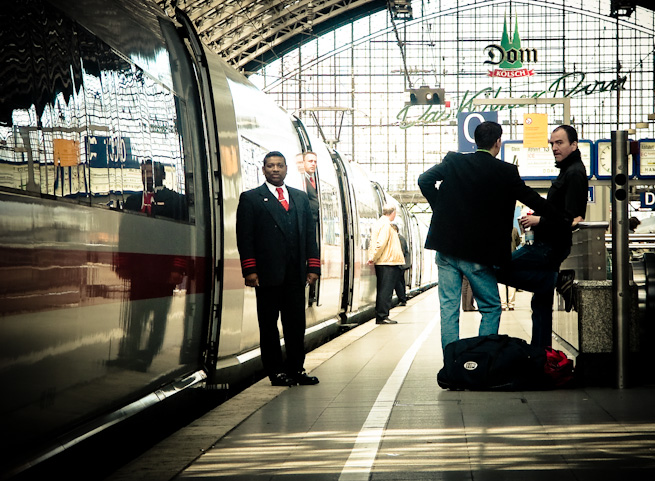
Last week I rambled about workplaces beyond rules. But when it came to naming my favorite workplace of all, I noticed how dependent it is on the work I want to do or the mood I’m in. But, as I said, if I’d have to choose one single place, it would probably be on board of a train somewhere in Germany.

The Marvels of Working on Trains

Why a train, of all things? As with the other places, vibe is a major factor. The atmosphere on a train is leisurely yet overall somehow concentrated: People are reading, watching a movie on their laptops or engaged in a relaxed conversation. Depending on the train, they might be talking some pretty weird (and often inspiring!) stuff – but if it gets too much, I simply put up some music and gone they are. (Ear plugs might work if you need silence to focus.)

There’s no dreadful radio music (as in many coffeeshops!) and, most of all, no wi-fi! I know that many people hate that and prefer taking one of the newer trains or routes that provide internet access for their passengers, but I personally hope that most trains continue to be offline territory. It’s precisely what seems to help to create the atmosphere that I enjoy so much.

On trains, dead time can easily be transformed into creative time. Watching out of the window and seeing the landscape pass by helps me more than anything to find the right words when crafting a new article or book chapter. You can get a coffee or some simple food in the dining car, but apart from that, distractions are low. You can walk around a bit whenever you feel like it, but it isn’t really incentivized. Preferably, you just remain seated and do some work. (And keep watching the landscape, of course!)

Talking of seats: Even the second class in the German train system is nowhere near as cramped as economy class on airplanes. Seats are bigger, there is sufficient space to use a laptop, and more often than not you’ll be lucky to have another free seat right next to you, allowing you to use two tables to have more space for your documents and paperwork.

Best of all, working time on a train comes with a hard deadline. As a regular reader, you might know already how important I deem these to be for higher productivity. A train ride might last 30 minutes, four hours, or maybe even a whole day. But when embarking, you know already that by 8.26pm you will reach your destination. That’s the time you’ve got, so there is no excuse not to use it.

The Cons

How about the downsides? Screaming children account for some of the negative experiences I have had. They simply aren’t helpful if you want to focus on your work. Overcrowded cars are worse. (Expect them during rushhour on commuter trains and before important holidays, like Christmas.) Overcrowded cars with lots of crying children… well, you get the idea!

The worst thing to encounter on a train, to be honest? Drunken football fans (that’s soccer in the US). They mostly ride regional trains (because they are incredibly cheap, especially for larger groups) and if they are in a bad mood, they will not only make work impossible, but life on trains in general. Fortunately, these guys are easy to avoid by simply not traveling during their peak hours. (Saturday afternoons, mostly. Sundays aren’t that bad, probably because most of them have to work the next day or face their spouses at night.)

One other major downside of working on trains might be the price! While competetive in comparison with airline prices, travel on German trains isn’t cheap – especially if you are a spontaneous traveler that doesn’t book his trips weeks ahead. A regular ticket from Hamburg to Munich, for example, will set you back 135 euros.

There are several discount cards available, though, that normally pay off over the year: Buy them once and get 25 to 50% discount on any ticket you buy later. The biggest temptation for me is the “BahnCard 100”: For about 4000 euros ($5200 USD, give or take) you get to travel as much as you want during a whole year. Just think of the possibilities!

Given my addiction to working on trains, I’m pretty sure that if I ever have that much spare, I might as well just get one of those cards and become a full-time train writer exploring every single city in the country. Until then, I’ll probably continue to work on the cheap regional trains, as long as there aren’t any football fans around!

Appendix

On December 25th, I embarked on an 8-hour train trip to Cologne, in order to join a big Christmas dinner on December 26th. That train trip wasn’t work-related, to be sure: One of my best friends and a good bottle of red wine accompanied me on that unconventional Holiday celebration on the road, and made 8 hours seem like 20 minutes. Conclusion: As a nice office, trains lend themselves for much more than just work!

Workplaces Beyond Rules

After the release of Productive Anywhere, a couple of readers asked me about my favorite place to get things done. Over the last few years, dozens of spots have been my home and my workplace, but which of them did I prefer?

As with many tough questions, it’s probably better to start at the opposing end and look at the workplaces I dislike: Cubicles! Luckily, I only had to work at one twice in my life. The first time was during a short job as a callcenter agent and the second during an internship with the European Commission’s Delegation to Colombia and Ecuador.

The callcenter job was hellish and mind-numbing by itself, as you might imagine. Screaming into a cheap and nasty headset trying to interview pensioneers and stay-at-home mums about their shopping habits is about as bad as it gets once a country moves beyond creating employment opportunities in sulfur mines. Now multiply the people screaming into those cheap headsets by 30 and put all of them into one large, overheated room and you’ll understand why I became highly motivated to get a different job immediately after starting out at the callcenter.

Work at the Delegation was much nicer and also way more interesting. I was even so lucky to have some great and smart colleagues – but my desk in the 11th floor of a random office building in Northern Bogotá simply didn’t feel like the appropriate place to do great work. Somehow, the atmosphere there did confirm the stereotypical image of a slow EU bureaucracy. As much as I enjoyed my stay there, I doubted that working in a cubicle (or even a normal office environment) would be something I’d enjoy doing in the long run.

Experimenting with Work Environments

To improve matters, I ended up cutting some of the office hours towards the end of my internship. To compensate, I transferred part of my work to the studio apartment I had rented in the lively Chapinero area. Even though it was a very simple place, this move alone spurred my productivity, as it entailed a whole new freedom: Suddenly, I was able to decide on my own about when to work and when to relax, when to walk around thinking and when to isolate myself from my surroundings in order to focus completely on my job.

In the following years, I continued to experiment with different work environments while finishing my academic studies in Germany and Colombia. Coffeeshops did work, but not for everything: Until today I love to go there for brainstorming, simple reading and light writing. Preparing exams, reading more complex texts or doing final edits, in contrast, is best done at other places. Libraries work great for this kind of stuff and also to get things done I don’t enjoy particularly: I remember locking myself away for whole weeks when preparing a painful linguistics exam. Being at a place full of quiet and concentrated students (most of them reading and memorizing data for their respective exams) simply created the right ambience.

Going Beyond Rules

Over the past couple of years, I took experimentation even further: I spent time working in parks and in beach bars, in the apartments of friends and strangers, on airplanes and airports, on buses and boats. All of these had their allures, and I’d love to go back to many of them because of the good experiences I made.

I experienced two of my personal highlights during the creation of my first two books. When I started to outline Beyond Rules ((Still available for free at the link. I will take it down later this month to start working on a 2012 update, so be sure to grab it now if you’re interested!)) I discovered my personal “author’s paradise” on Earth: A cozy hotel right at the beach in Cartagena. In the shadowy patios, artists, writers and part-time philosophers of all sorts encounter Colombian tourists, elderly world travelers and the occasional group of students. The resulting energy provides the ideal surroundings for me to let my mind wander, get inspired and put a text together.

Later on, I made major breakthroughs for both Beyond Rules and Productive Anywhere at the shores of the North Sea in Denmark and Germany. This was a great environment to dive deeply into the chapters of the books and slog away for a couple of hours. Whenever it got too much and I felt like my head was exploding, going out to breathe some fresh air and get myself almost blown away by the stormy winds was just perfect to get unstuck!

My Favorite Workplace

So were these my favorite workplaces? In some sense, yes – but only in the context of what I was doing at the time! I believe that being able to choose our workplace on our own brings two huge advantages. First of all, our motivation will be higher, as described above: Choosing freely about when and how to work is an empowering experience. Secondly, different environments lend themselves better for different kinds of tasks: The library for concentrated editing, the beach hotel to get inspired, and so on.

The major downside to choosing our own workplace is probably friction: Finding out about what works and what does not is only in some part a matter of common sense or scientific research. To a large degree it’s a question of personal preference and also of the circumstances of your life. Also, procrastination can be much more tempting if there isn’t anybody around controling you. Choosing your workplace wisely thus becomes much more important. ((More thoughts on these issues can be found in Productive Anywhere, of course! In her interview, Lea Woodward shares some very interesting thoughts on how sometimes even a great place can be a bad fit for us to get things done.))

So what’s my favorite workplace, then? It’s hard to say. But if I’d have to choose one, I’d probably go for… no, I won’t put this here. It’s worth a post of its own, so I’ll keep it up for next week! Be sure to come back or subscribe for free to my RSS feed!

Barbecue Laws

An interesting excerpt from the (excellent) book Willpower by Roy F. Baumeister and John Tierney:

In nineteenth-century America […] there was a social convention called the “barbecue law,” which meant that all the men who gathered for a barbecue were expected to drink until they were soused. To refuse a drink entailed a serious insult to the host and the rest of the party.

Now, if you have been following my writings on TFA for a while, you know already that I’m not exactly an opponent to the occasional drink. More precisely, I used to be a rum collector when I still had an apartment and a good spirit can normally be found somewhere in my luggage, ready to celebrate with friends whenever I meet (or make) them.

(Time for a tangent: I already told you about the German proverb which says that you should celebrate the feasts as they come. I’m a huge believer in this. Really great parties are rarely planned and much more often simply turn up “like that”. This makes me think that the old pagan gods of wine and merriness probably do exist.

I remember once, when I was in Rome, a friend of mine and I went to an ice cream parlor near Fontana di Trevi in search for a restroom. The owners weren’t eager to lend their facilities to non-customers, so we ordered two beers and off we ran to the bathroom.

When we came back we started to joke with them about the location of their business and the funny experiences they had made with tourists over the years. When they found out that we were Germans, they immediately started to ask us about the Love Parade. (This episode happened back in the late 90s, so Love Parade was still existent and en vogue at the time.)

As it turns out, the guys were huge techno fans – and my friend was a semi-professional DJ who also happened to carry a couple of DJ sets from that year’s “Abschlusskundgebung,” the Love Parade’s great finale. Memories are blurry, but it didn’t take the owners more than five minutes to close the parlor down, open the bar and get that tape playing. We spent several hours there, drinking, repeatedly listening to the sets, talking a hodgepodge of German, English and Italian, dancing and joking around. When we finally left, daylight was already approaching at the Eastern skies.

Now, before I totally lose my tangent, let’s sum it up: While I didn’t travel with booze back then and the real clou of this story was without doubt the Love Parade tape my friend brought along, making new friends and celebrating whenever we get the chance to definitely is a good thing to do. End of tangent.)

Now, back to the main topic: “Barbecue Laws.”

I probably lost all my credibility somewhere between the words “rum collector” and “I spent several hours drinking in an Italian ice cream parlor”.

BUT!

Starting to drink just because of some social convention is something I have done at several points in my life. At barbecues and at other places. But: It’s also something I’m happy to do less now than I did in the past. Why that? Well, probably because drinking just to follow some social convention strikes me as extraordinarily silly.

Consequently, breaking this “barbecue law” sounds like a good idea.

But then, of course, there’s another notion to it that I cannot ignore here on TFA. Because socially enforced drinking isn’t the only social convention that’s extraordinarily silly, is it?

Actually, I worry there are many, many other “barbecue laws” nowadays.

And I personally prefer to break at least some of them.

Like the law to buy tons of useless stuff to give away for Christmas. (Another tangent, but let’s make this shorter: If I don’t stumble on something that seems like a great fit for a loved person, I’ll simply buy food. And, ahem, drinks. Everybody likes good food and good drinks, they don’t occupy storage space in your apartment (at least not for a long time), and if you don’t like them you can easily give them away without anybody noticing. A perfect gift, as far as I am concerned.)

Or the law to overeat during holiday season only to go on a diet later on. (Really, isn’t this weird? I mean, the dark winters in the Northern hemisphere certainly suck, but is binge-eating the best answer to that? Better get a flight to the Tropics!)

Or how about the “barbecuest ((Grammar police will shoot me. Barbecue, barbecuer, barbecuest.)) law” of all: The law to get up at 7am, board a loud and stinking car by 8, drive to an ugly glass-and-concrete building and sit down at some desk by 9, only to do senseless busywork until the clock hits 5pm.

Really, let’s find a loophole for these laws! Let’s start accepting the invitations to the barbecue (if we’re fine with them), but let’s keep the booze out of the game if we don’t feel like drinking. Or the hollow Christmas gifts. The binge-eating. The busywork.

“Barbecue laws” are both legally and morally superfluous.
Let’s break them and replace them with something better.